The Ledger & the Blockchain
Picture a shared notebook nobody can secretly erase.
⏱ About 9 min
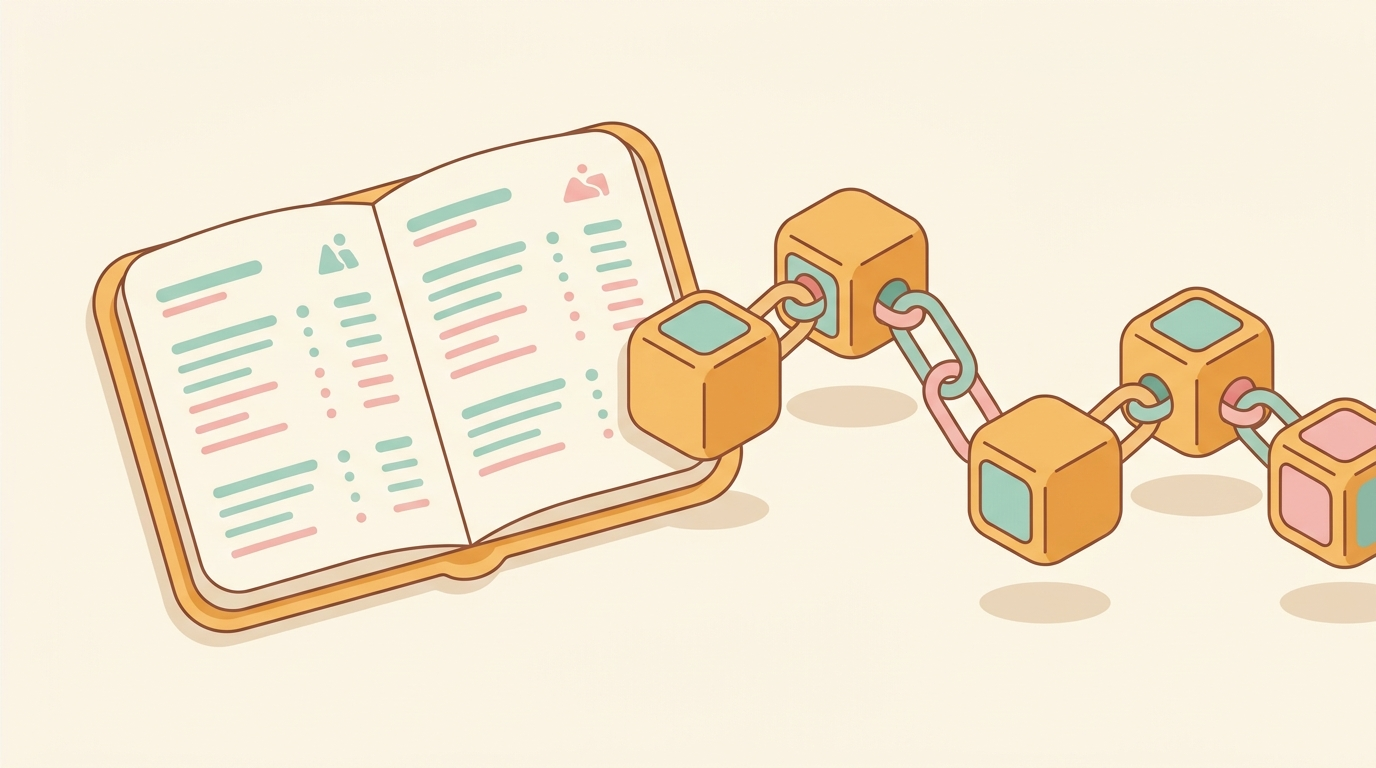
By the end of this module you’ll be able to:
- Understand the blockchain as one public, shared ledger of every transaction
- See how transactions are bundled into blocks and chained together by fingerprints
- Explain why the ledger is so hard to change, and why thousands of copies matter
You've heard the word blockchain a hundred times. Strip away the buzz and it's a surprisingly homely idea: a shared notebook of who paid whom — one that thousands of strangers keep copies of, and that nobody can quietly rewrite.
One public notebook, copied everywhere
At its heart, Bitcoin is a ledger — a running record of every transaction that has ever happened. There's just one catch that makes it special: instead of a bank keeping the only copy, thousands of independent computers around the world each keep their own identical copy and keep it in sync.
- Ledger
- A record of transactions — who sent what to whom. Bitcoin's ledger is public: anyone can download and read the entire history, all the way back to the first transaction in 2009. Nobody owns it or controls it.
The shared notebook
Imagine a notebook recording who paid whom — except thousands of people worldwide each hold an identical copy. When a new payment happens, everyone updates their copy at the same time. Because so many independent people hold matching copies, no single person can secretly erase or fake an entry. If their copy disagrees with everyone else's, it's simply ignored.
It records moves, not balances
The notebook doesn't store a tidy 'account balance' next to your name like a bank app. It records movements of bitcoin between addresses. Your balance is just the sum of the coins sent to you that you haven't spent yet — added up on the fly.
Blocks: one page at a time
New transactions aren't written in one at a time. They're collected and added in batches. Each batch is a block — think of it as one page of the notebook, holding a bunch of recent transactions plus a timestamp.
- Block
- One page of the ledger: a bundle of recent transactions, a timestamp, and a reference to the page before it. A new block is added roughly every 10 minutes.
That roughly every 10 minutes is an average, not a stopwatch. Individual blocks can arrive seconds apart or take half an hour. The network automatically tweaks the difficulty about every two weeks to keep the long-run pace near ten minutes.
Myth
"A new block appears exactly every 10 minutes, like clockwork."
Reality
Ten minutes is only the average target. Real blocks come at uneven intervals; the network just nudges the difficulty up or down to keep the long-run average steady.
Chaining the pages together
Here's where block-chain gets its name. Before starting a new page, you copy a special seal from the bottom of the previous page onto the top of the new one. This locks the pages into a strict order, stretching all the way back to the very first block.
- Hash (a digital fingerprint)
- A short string of characters produced by running data through a one-way math function. Any tiny change to the data — even one comma — produces a completely different fingerprint. So a hash acts as a tamper-evident seal for a block's exact contents.
A wax seal on every page
A hash is like a wax seal made from the page's exact contents. Change even one comma and the seal looks totally different. Each new page stamps the previous page's seal onto itself, so the pages are linked in a fixed sequence — and any tampering breaks the chain of seals.
Because each block carries the fingerprint of the one before it, the blocks are stacked in a fixed order. Rewrite an old page and its fingerprint changes — which no longer matches the seal copied onto the next page, and the next, and the next. The tampering sticks out instantly.
Why it's so hard to change (immutability)
This is what people mean when they call the blockchain immutable: not literally impossible to change, but so impractical that, in the real world, confirmed history just doesn't get rewritten.
- Immutable / append-only
- You can add new pages to the end, but you effectively can't edit old ones. Past entries are locked in by all the blocks stacked on top of them.
Ink, not pencil
Old entries are written in permanent ink and then buried under thousands of later pages. To change one old entry, you'd have to redo that page and every single page stacked on top of it — faster than the entire rest of the world is adding new pages. In practice, that's impossible.
So no, a hacker can't just 'edit the blockchain'
A common fear is that a powerful hacker or government could quietly delete or change a transaction. Rewriting confirmed history would mean redoing the work for that block and every block after it while out-racing the whole global network at once — economically and practically infeasible.
Who keeps it honest: nodes & decentralization
The ledger isn't stored in one place. It's copied and maintained by tens of thousands of independent computers called nodes, scattered across 170+ countries. Each full node keeps its own complete copy and independently checks that every transaction and block follows the rules.
- Node
- An independent computer running Bitcoin software that stores a full copy of the ledger and verifies every transaction and block against the rules — no central server required.
Referees, not a boss
Every full node is an independent referee holding the complete rulebook. When a transaction or block arrives, each referee checks it: Is the money real? Was it already spent? Does it follow the rules? Cheating blocks get rejected by the crowd of referees, so no central umpire is needed.
- Decentralization
- No central server, company, or bank is in charge. The network agrees on one shared version of history through rules every node enforces, rather than trusting a single authority.
A potluck, not a restaurant
A bank is like one restaurant kitchen everyone must trust. Bitcoin is like a potluck where thousands of independent guests all bring and check the same dish. No single kitchen can spoil the meal or shut it down.
Confirmations: how a payment 'sets'
When your payment first lands in a block, it has one confirmation. Each new block mined on top of it adds another, making the payment progressively harder to reverse.
- Confirmation
- A count of how many blocks have been stacked on top of the block containing your transaction. More confirmations = more buried = harder to undo. Many services treat about 6 confirmations (~1 hour) as effectively final.
Wet cement setting
Landing in a block is like writing in wet cement. The first confirmation is the cement starting to set; each new block on top is another layer hardening over it. After about six layers — roughly an hour — it's set so solid that reversing it is considered practically impossible.
Public, but not anonymous
The ledger records bitcoin moving between addresses (long strings of letters and numbers), not names. That makes it pseudonymous, not anonymous — the whole history is public and traceable, and with analysis, addresses can sometimes be linked to real identities.
Build a block
Your turn. Gather a few pending transactions, bundle them into a block, stamp on the previous block's fingerprint, and watch it chain onto the ledger — then see what happens if you try to tamper with an old page.
- Fill the block
- Seal it
- Chain it
The waiting room (mempool)
These payments are waiting to be confirmed. Your block has room for 3. Tap to add the ones you’ll include — higher fees are a nice tip for doing the work.
Check your understanding
Question 1 of 3
What is a 'block' in the blockchain?
Question 2 of 3
Why is it so hard to secretly change an old transaction in the blockchain?
Question 3 of 3
What does it mean that the ledger is 'decentralized'?
Key takeaways
- The blockchain is one public, shared ledger of every Bitcoin transaction — copied by computers worldwide, owned by no one.
- Transactions are bundled into blocks (pages), added roughly every 10 minutes on average.
- Each block carries the previous block's fingerprint (hash), chaining them in order and making tampering instantly obvious.
- Tens of thousands of independent nodes each keep a full copy and enforce the rules — that's decentralization.
- More confirmations mean a payment is buried deeper and harder to reverse; ~6 is treated as effectively final.
Tip: finish the interactive activities above to get the most out of this module.