Mining: How New Bitcoin Is Made
A global guessing game that secures the network — and mints new coins.
⏱ About 9 min
By the end of this module you’ll be able to:
- Understand mining as a costly guessing game (proof-of-work), not 'solving useful problems'
- See how miners earn the block reward plus fees — and why that secures the whole network
- Make sense of difficulty, hashrate, and the energy debate in a balanced way
Where do new bitcoin actually come from — and who keeps the whole ledger honest? The answer to both questions is the same thing: mining. It's far less mysterious than it sounds.
Mining is a giant guessing game
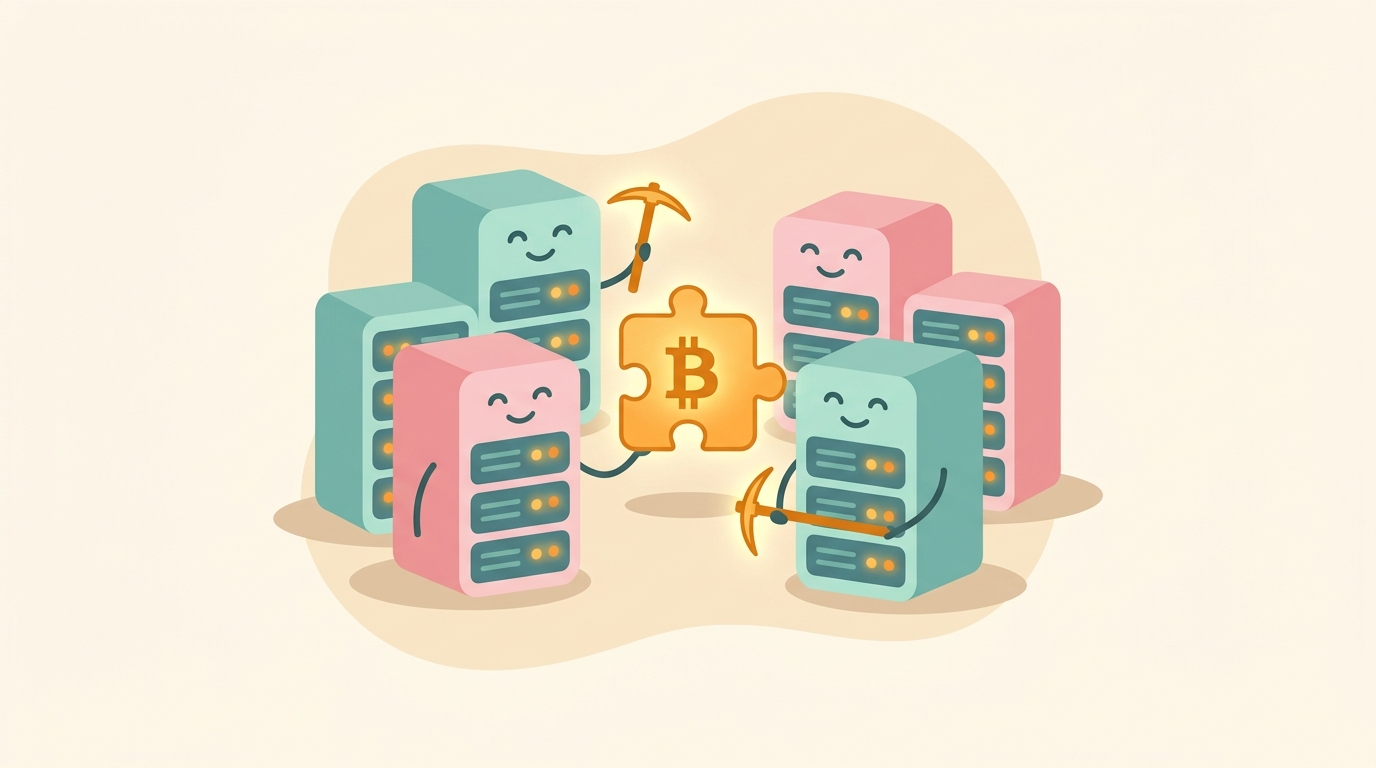
Every ten minutes or so, computers all over the world race to add the next page of transactions — the next block — to Bitcoin's shared ledger. To win the race, they don't solve clever puzzles. They just guess, trillions of times per second, until one of them stumbles onto a winning number.
- Mining
- The process that does two jobs at once: it confirms new transactions into the ledger AND creates new bitcoin as a reward. Specialized computers compete to add each new block, roughly every 10 minutes.
- Proof-of-work
- The rule of the game. Miners feed the block's data plus a changing number through a one-way math function over and over, hunting for an output below a target. There's no shortcut — it's pure trial and error — but once someone finds the answer, everyone else can check it's correct in a split second.
A combination lock with no shortcut
Proof-of-work is like a padlock you can only open by trying numbers one at a time. It takes the whole world's miners about ten minutes to crack each lock — but the instant it pops open, anyone can glance at the answer and confirm it fits. Hard to produce, easy to check.
Myth
"Mining solves useful math problems or cracks codes for science."
Reality
The guessing is deliberately useless. Its only job is to be costly and impossible to fake — and that cost is exactly what protects the ledger.
The prize: new coins plus fees
Why would anyone burn all that computing power? Because the winner of each block collects a reward. It comes in two parts: brand-new bitcoin minted by the network (the block subsidy), plus all the transaction fees from the payments packed into that block.
That subsidy is the only way new bitcoin is created — and it's cut in half roughly every four years in an event called the halving (the focus of the next module). Mining isn't free money: miners pay real-world costs in hardware and electricity to earn it.
A global lottery that reruns every ten minutes
Picture a lottery that draws a fresh winner every ten minutes. Each miner buys 'tickets' by making more guesses per second. The more guessing power you bring, the more tickets you hold — and the more likely you are to win the right to write the next page and collect the prize.
Myth
"You can get rich mining Bitcoin on your laptop or phone."
Reality
Competitive mining needs purpose-built machines called ASICs and very cheap electricity. Phone and laptop 'mining' apps earn essentially nothing and are often outright scams.
Why this secures the network
Here's the clever part. Once a block is buried under newer blocks, rewriting it would mean redoing all its proof-of-work — and then out-racing every honest miner on Earth going forward. To pull that off you'd need to control more than half of all the world's mining power.
- 51% attack
- An attempt to overpower the network by controlling a majority of mining power. At today's scale it would cost staggering sums in hardware and electricity — which is why honest mining is far more profitable than cheating.
Electricity as a fence around history
The energy miners spend acts like a fence around the ledger. To rewrite the past, an attacker would have to re-crack every lock from that point on — faster than everyone else combined. Cheating would cost more than it could ever pay, so the rational move is to play fair.
What an attacker could — and couldn't — do
Even with a majority of mining power, an attacker mainly could try to reverse their own very recent transactions (a 'double-spend'). They could not steal coins from other people's wallets or conjure new coins out of thin air — the network's rules reject that outright.
Difficulty and hashrate, in plain words
Two numbers come up constantly when people talk about mining. They sound technical, but the idea behind each is simple.
- Hashrate
- The total guessing power of the whole network — how many attempts per second all miners make combined. It's now measured in exahashes per second (EH/s), where 1 EH/s is a quintillion (a billion billion) guesses every second. A higher hashrate means a more secure, harder-to-attack network.
- Difficulty
- A self-adjusting dial that recalibrates about every two weeks to keep blocks arriving near every 10 minutes. If more miners join and blocks come too fast, difficulty rises; if miners leave, it falls.
A treadmill that keeps your pace steady
Difficulty is like a treadmill that automatically speeds up or slows down. If too many runners pile on and blocks arrive too quickly, the network makes the locks harder so the average stays at ten minutes. If runners drop off, it eases up. The heartbeat stays steady no matter how many miners come and go.
High, but not a record
Difficulty sits around 125 trillion right now — very high by historical standards, yet roughly 10% below the early-2026 peak near 144 trillion. It rises and falls as miners join or leave; it isn't an all-time high today.
The energy question, honestly
Bitcoin mining uses a real and significant amount of electricity — recent industry estimates put it in the range of roughly 140–175 terawatt-hours a year, on the order of half a percent of global electricity. That's a fair thing to take seriously, and it's worth seeing both sides clearly.
What critics point to
- Large absolute electricity use (~140–175 TWh/year)
- Carbon emissions where the power comes from fossil fuels
- Electronic waste from short-lived specialized hardware
What advocates point to
- A rising share of sustainable power — recent estimates put renewables plus nuclear above half the mix
- Use of stranded or flared gas that would otherwise be wasted
- Miners can switch off instantly, helping balance electrical grids at peak demand
Turning wasted gas into electricity
Oil drilling often releases natural gas in remote spots with no pipeline, so companies simply burn it off into the air — pure waste. Some miners set up on-site to turn that otherwise-flared gas into power for mining. Advocates say this captures waste; critics question the net climate benefit. The honest summary is: it's genuinely mixed, and genuinely debated.
Myth
"Every Bitcoin transaction has a fixed, enormous energy cost."
Reality
Energy secures the network over 10-minute blocks no matter how many transactions are inside. 'Energy per transaction' is an accounting choice, not a physical per-payment cost — and second layers can batch many payments together.
Where the debate really stands
This one isn't settled in either direction. The electricity use is real; so is the shift toward cleaner sources and grid-balancing uses. A beginner who can hold both of those facts at once understands the topic better than most headlines do.
Check your understanding
Question 1 of 3
What are miners actually doing when they 'mine' a block?
Question 2 of 3
How do miners get paid for winning a block?
Question 3 of 3
Which statement about Bitcoin's energy use is the most accurate?
Key takeaways
- Mining is a costly guessing game (proof-of-work): hard to win, instantly easy for anyone to verify.
- Winners earn newly minted bitcoin — currently 3.125 BTC per block — plus the transaction fees in that block.
- That spent energy secures the ledger: rewriting history would cost more than it could ever pay.
- Difficulty auto-adjusts to keep blocks near 10 minutes; hashrate (~900–950 EH/s) measures the network's total guessing power.
- Bitcoin's energy use is significant and real, with a rising sustainable share and grid-balancing uses — a genuinely mixed, debated picture.
Tip: finish the interactive activities above to get the most out of this module.